

Food & Beverages • Season 1 • Episode 10
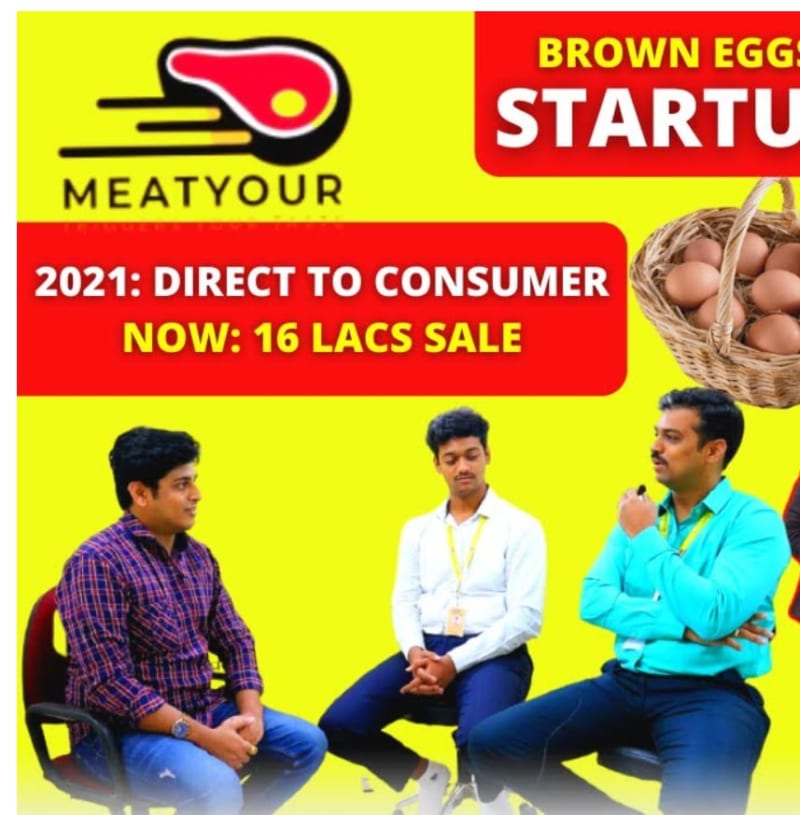
Meatyour,Eggs Agro Products Private Limited
Starts From - ₹800
Where to Buy
Sharks Invested


Product Details
Entrepreneur Background
Saisharan shared that in 2015, his father Vardhaman brought 15 hens, and by 2022, they had 20,000 hens. When the first chicken gave the first egg, they sold it for ₹50 — and from there, Meatyour started. BizzBucket That first egg sold for ₹50 is both an origin story and a commercial metaphor: a single egg, from a single hen, was the proof of concept for a company that would eventually manage 20,000 hens and distribute across Mumbai and Pune. Vardhaman Gandhi is the patriarch and the farming soul of Meatyour. Vardhaman was an accountant in the Pune area, where he worked for several dairy farming companies, learning about this business. Arnav Gandhi, Vardhaman's son, is an IT engineer who left his corporate career to join the family business. Saisharan Gandhi (also called Sai), the other son, is a civil engineer. Both Arnav and Sai left their dream jobs and helped their father as he loved and wanted to connect with nature.
The Product / Service
The farming philosophy — "Happy Egg" concept: It is an open environment that provides fruit and vegetables for the chickens, and for additional nutrition they eat worms and insects. Bizlitesolutions This free-range, natural-diet farming approach is the foundation of the product's differentiation. Conventional commercial egg production in India involves battery cages — hens confined in tiny wire enclosures with no room to move, fed a concentrated industrial feed. Meatyour's hens roam freely, eat natural food from the farm environment, and are not given artificial growth hormones or antibiotics. The odourless egg claim: The founders specifically highlighted that Meatyour eggs are odourless — a reference to the sulphurous smell characteristic of commercially produced eggs from factory-farmed hens.
The Ask
Amount Asked: ₹30 lakhs Equity Offered: 5% Implied Pre-Money Valuation: ₹6 crore
Pitch Presentation
The opening statistic established the market scale immediately: according to data provided by Meatyour, 300 million eggs are sold every day in India, with 80 lakhs (8 million) sold in Mumbai alone. In a market of this size, even a 0.1% share represents enormous absolute volume. The pitch positioned Meatyour not as a niche product for premium consumers, but as an ethical alternative to commodity eggs for the mainstream Indian household — a market-timing argument rooted in India's accelerating consumer shift toward cleaner, traceable food sources. The family founding story was narrated warmly: Vardhaman's 2015 purchase of 15 hens, the first egg sold for ₹50, the gradual growth to 20,000 hens over six years, and the sons' decision to leave engineering careers to build the business together. This is the kind of story that resonates with every Indian family viewing — a father's passion, children's loyalty, and collective family sacrifice for a shared vision.
Sharks' Reactions & Criticism
Ashneer Grover was the first to exit and the most commercially direct. Ashneer exits the deal first, as he believes it's impossible to make money in India by delivering any product that costs less than ₹300 to consumers' doorsteps. Namita Thapar exited on category grounds. Namita also declines, stating that she is not excited about selling eggs and lacks expertise in this business. Peyush Bansal was intellectually engaged but placed structural conditions on his investment. Peyush suggested that they need to merge both B2B and B2C businesses together, and bring someone outside the family as co-founder to look after technology and supply chain. Anupam Mittal pushed back on Peyush's co-founder condition. Anupam on the other hand feels that a co-founder will add to trouble. Aman Gupta was interested in the brand's D2C potential and the ethical farming story.
Negotiation & Offers
Despite Ashneer and Namita exiting, the remaining three Sharks — Anupam, Aman, and Peyush — coalesced into a joint offer. Peyush, Anupam, and Aman all came together and offered ₹30 lakhs for 20% equity. The offer matched the founders' rupee ask exactly (₹30 lakhs) but quadrupled the equity from 5% to 20% — implying a valuation of ₹1.5 crore versus the founders' ₹6 crore ask, a 75% markdown from the original valuation. The three Sharks were collectively pricing the early-stage, pre-scale risk heavily into the equity terms. The founders accepted on-screen — choosing three investors who between them brought internet consumer expertise (Anupam), consumer brand building and D2C marketing (Aman), and retail operations and last-mile distribution knowledge (Peyush).
Final Verdict
On-Screen Deal₹30 lakhs for 20% equity (Anupam + Aman + Peyush)