
Eco-Friendly & Sustainable • Season 3 • Episode 18
ECO BioTraps
Starts From - ₹1,126
Where to Buy
Product Details
Entrepreneur Background
Prasad Harish Wadke, an entrepreneur from Mumbai, worked in high positions at top-tier firms such as Nvidia, Hewlett-Packard, and Autodesk. He left his salary package running into crores to begin a startup, Eco BioTraps. LinkedIn Prasad Phadke is Season 3's most corporately credentialled social enterprise founder a former Nvidia, HP, and Autodesk senior professional who left a crore-plus annual salary package because a mosquito bite at a San Francisco restaurant in 2017 made him ask: despite all of humanity's technological advances, why have we still not solved the mosquito problem? Working in close collaboration with scientists and other like-minded persons, Prasad had begun developing a product called Eco BioTrap aimed at reducing the population of mosquitoes and the incidence of vector-borne diseases they carry like dengue, malaria and chikungunya.
The Product / Service
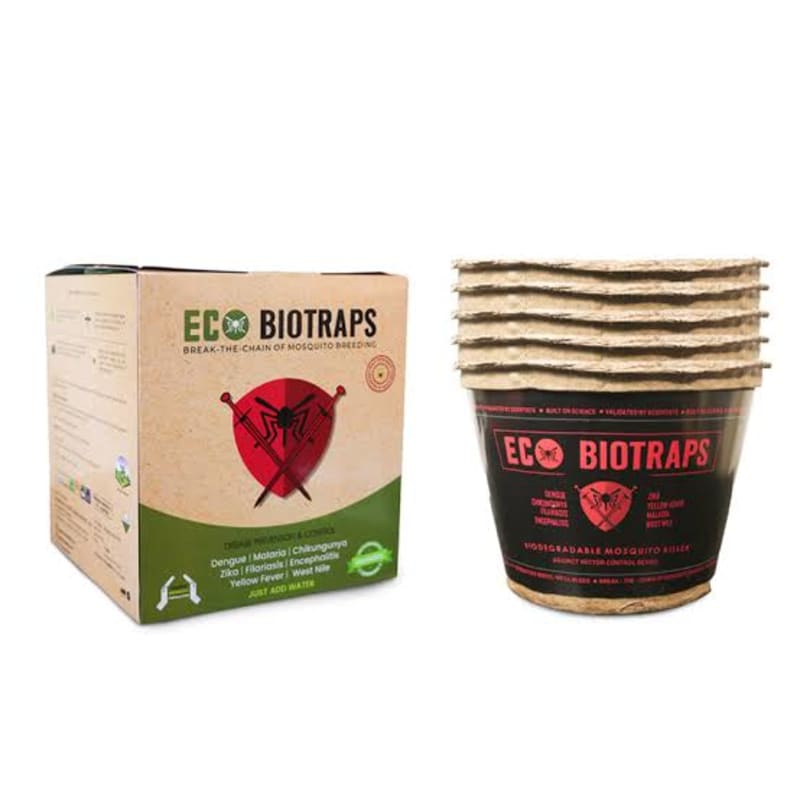
Eco BioTraps is a for-profit social enterprise that works on recycling waste items and turning them into Eco Biotraps, a biodegradable product that breaks the chain of mosquito breeding. By doing so, it saves lives from Dengue, Malaria, and other mosquito-borne diseases. ECO BioTraps is the world's first 100% biodegradable mosquito population reduction device. Rather than repelling or killing adult mosquitoes (which are replaced within days by newly hatched ones), EBT mimics ideal breeding conditions to attract female mosquitoes to lay their 500 to 1,000 lifetime eggs inside the trap, then destroys those eggs through a slow water drainage mechanism, breaking the reproductive cycle at the source. While a common mosquito can fly up to 1 kilometre, a dengue mosquito can fly only up to 100 to 200 metres. Eco BioTraps claims that if its product is used continuously in an area, dengue mosquitoes can be eliminated within a radius of about 200 metres in 3 to 6 months.
The Ask
Amount Asked: ₹50 lakhs Equity Offered: 2% Implied Pre-Money Valuation: ₹25 crore
Pitch Presentation
Harish Phadke started the pitch by sharing the fact that mosquitos are one of the deadliest things in the entire universe. Prasad, Nitin, and Binal opened Season 3 Episode 18 with the most statistically alarming public health pitch of the season: 10 lakh people die globally every year from mosquito-borne diseases, making mosquitoes the deadliest creature on Earth. The founders framed ECO BioTraps not as a consumer convenience product but as a public health intervention that addressed the root cause (breeding) rather than the symptoms (biting). The product demonstration showed the simple mechanism: fill the biodegradable pot with water, dissolve the two sachets, place it outdoors. Female mosquitoes are attracted to lay eggs inside. The slow water drainage destroys unhatched eggs. The simplicity was the pitch's commercial strength and its Shark credibility challenge simultaneously: Namita specifically questioned why consumers would buy this product instead of filling a bucket with a similar solution at home.
Sharks' Reactions & Criticism
Amit Jain asked detailed questions about the process and how the product works. Anupam Mittal questioned what core technology made ECO BioTraps truly unique compared to other breeding-disruption approaches. Namita Thapar delivered the most commercially challenging question: why would consumers pay ₹499 for a biodegradable pot when they could achieve a similar effect with a bucket and water at home? She exited on pricing and consumer adoption grounds. Aman Gupta appreciated the social mission but found the business commercially too early-stage (₹86 lakhs revenue with 4% net margin) for his investment framework. Vineeta Singh was the only Shark who saw fundable potential despite agreeing with other Sharks' concerns.
Negotiation & Offers
Vineeta offered ₹50 lakhs for 10% of the company. The founders countered Vineeta with a ₹15 crore valuation which she declined so ECO BioTraps walked out of Shark Tank without a deal. InsideSport Vineeta offered ₹50 lakhs for 10% equity (₹5 crore valuation). The founders countered at approximately 3.33% equity (₹15 crore valuation). Vineeta declined the counter. The valuation gap (₹5 crore vs. ₹15 crore) could not be bridged, and the founders chose to walk away rather than accept 10% dilution at what they considered a dramatically undervalued assessment.
Final Verdict
Prasad Phadke, Nitin Khope, and Binal Shah left Shark Tank India Season 3 Episode 18 without any investment. Vineeta's offer, the only formal offer made, was declined because the founders found the ₹5 crore valuation (versus their ₹25 crore ask) commercially unacceptable. The founders' decision to reject the only available offer communicated strong conviction in their product's long-term value, though the post-show Amazon consumer reviews would subsequently challenge that conviction.
Beyond Shark Tank
Our research into ECO BioTraps revealed that despite not getting a deal on Shark Tank India, the show had a positive impact on the company. This gave them nationwide recognition and validation. The founder appeared on Editorji for an interview where he shared that they would be in Malaysia, Nepal, and Zambia by the end of 2024. ECO BioTraps continues operating with ambitious international expansion plans (Malaysia, Nepal, Zambia) and BMC institutional support in Mumbai. The ecobiotraps.com website remains active with direct ordering and the product is available on Amazon. However, the post-Shark Tank consumer reception has been significantly challenging. Amazon reviews present a concerning picture: 28 out of 37 customer mentions about effectiveness are negative, with multiple customers reporting zero mosquito reduction and calling the product a "complete waste of money."